Brooke Eby, the social media creator who transformed her devastating ALS diagnosis into a story of honesty, humour and connection, has died at the age of 37.
For four years, Brooke invited hundreds of thousands of people into a part of her life that most would have struggled to speak about publicly.
She documented the physical changes, the fear, the awkward moments and the uncertainties of living with amyotrophic lateral sclerosis — but she also showed something else.
She showed people how to keep laughing when life no longer looked anything like the future they had imagined.
The ALS Network confirmed her passing on October 1 and described her as an “extraordinary advocate, storyteller, community builder, and friend” whose honesty and determination changed how people understood ALS.

Her final post now carries a different meaning
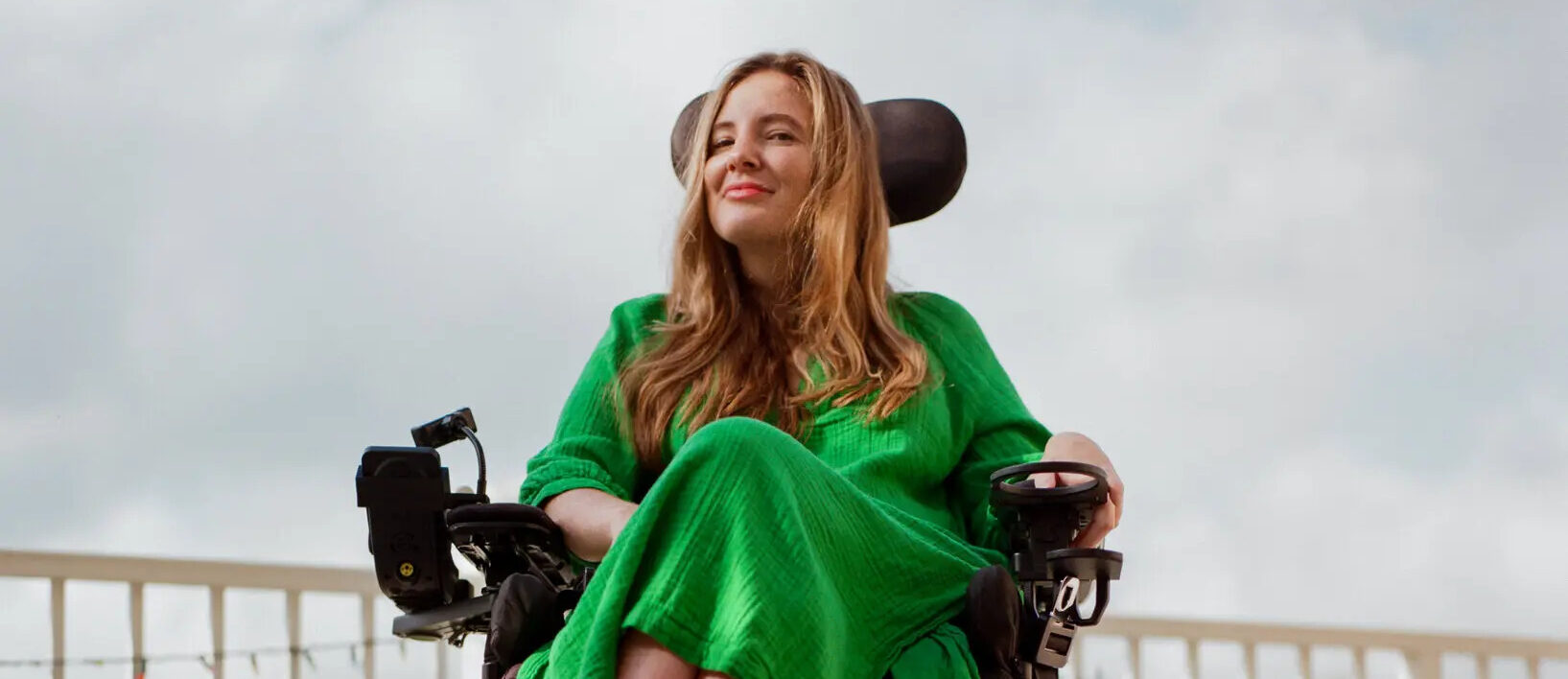
One of Brooke’s final social-media posts showed her modelling pieces from her adaptive clothing collaboration with Silverts.
The post was made on September 30, just before news of her passing emerged. Brooke wrote that she had been planning the collection for a long time and was excited to finally share it with her followers.
At the time, it was simply another Brooke Eby post.
Now, with her death confirmed, followers have returned to it with a very different feeling.
It was one of the last glimpses of Brooke doing exactly what she had spent years doing online — creating, joking, dressing up and refusing to let ALS become the only thing people saw when they looked at her.
The diagnosis that changed everything
Brooke was diagnosed with ALS in March 2022 at the age of 33.
But the story had started years earlier.
She has said her first symptoms appeared when she was 29, when she noticed unusual tightness in one calf and began limping. At the time, she had recently moved from San Francisco to New York and was working in technology sales at Salesforce.
The early signs were initially difficult to explain.
Her sister and brother-in-law, both doctors, wondered whether the problem could be a pinched nerve.
Tests continued for years.
By 2020, doctors were considering ALS, but she was not diagnosed until 2022, when the condition had progressed significantly.
The eventual diagnosis changed the direction of her entire life.

Her first reaction was not inspirational
One of the things that made Brooke different was that she never pretended a terminal diagnosis was easy.
In a 2025 personal essay for People, she described the first months after learning she had ALS as a period of shock and profound sadness.
She wrote that she struggled to know what to do next and spent much of that time in bed trying to escape the reality of what had happened.
There was no immediate transformation into the fearless advocate millions would later know.
That came gradually.
And, surprisingly, humour became one of the tools that helped her get there.
The wedding that changed the way she saw her illness
One of Brooke’s most memorable stories involved attending a friend’s wedding with a walker.
She initially felt embarrassed about arriving with the mobility aid and considered leaving early.
Instead, one of her closest friends encouraged her to stay.
Brooke eventually started joking about the walker and noticed something important: once she laughed, the people around her became more comfortable too.
She later wrote that the experience helped her realise humour could make difficult situations easier to navigate — for other people, but also for herself.
That idea would become central to her online presence.
Then millions began watching
Brooke started documenting her life online under the name @limpbroozkit.
Her videos were rarely what people expected from someone living with a terminal illness.
She talked about dating.
She shared “get ready with me” videos.
She spoke about medication and mobility.
She made jokes about situations that could otherwise feel unbearably heavy.
And she did not hide the realities of what ALS was doing to her body.
That combination of humour and honesty attracted hundreds of thousands of followers across TikTok and Instagram. Recent profiles put her following at close to 600,000 across platforms.
But Brooke’s goal was never simply to become an internet personality.
She wanted people to understand ALS differently.

“I didn’t choose ALS, but I did choose to get loud”
As her following grew, Brooke increasingly used her platform for advocacy.
In March 2026, the ALS Network named her its 2026 Dean and Kathleen Rasmussen Advocate of the Year, recognising her work raising awareness, building community and supporting other people living with the disease.
When accepting the honour, Brooke said:
“I didn’t choose ALS, but I did choose to get loud.”
She added that she was grateful the award showed that her unconventional approach was helping people.
It was a fitting description of what she had built.
She never tried to make her story neat.
She simply refused to make it invisible.
She created something that could survive without her
Perhaps Brooke’s most lasting contribution came through ALStogether, a peer-support community she helped create with colleagues from Salesforce.
The idea was simple but deeply practical: people living with ALS and their caregivers needed somewhere to exchange information, advice, resources and lived experience without having to navigate everything alone.
By 2024, the online community had become a dedicated space for people affected by ALS.
And Brooke eventually realised that for it to survive, it needed something she could not guarantee on her own.
In 2026, ALStogether became part of the ALS Network, giving the community greater resources and continuity.
Brooke herself described the move as an opportunity for her “baby” to keep growing without depending entirely on her ability to continue running it.
That decision now feels especially significant.
She had built something designed to continue beyond her.
Her body changed. Her purpose did not.
As the disease progressed, Brooke experienced increasing mobility and speech difficulties.
Yet she continued creating content.
The Cut reported that she eventually relied heavily on her parents for daily care and used specialised equipment, including a powered wheelchair and breathing support. Despite severe physical limitations, she continued engaging with her audience and raising money for ALS causes.
Her openness also confronted one of the misconceptions surrounding ALS: that it is primarily an illness of old age.
Brooke was only 33 when she received her diagnosis.
Much of her advocacy centred on making people understand that a young person could suddenly find themselves facing the same disease.
She wanted her story to outlive her
Perhaps the most haunting part of Brooke’s story is that she had already thought about what would happen to her social-media archive after she was gone.
In her 2025 People essay, she wrote that she hoped her TikTok presence would remain available after her death.
She wanted it to become a kind of visual diary for someone who might receive an ALS diagnosis in the future and need to understand what life with the disease could look like.
It is difficult to read those words now without seeing them differently.
What she once described as a record of her life has become part of her legacy.
A voice the ALS community will not forget
The reaction to Brooke’s death has been immediate.
The ALS Network said she “changed the way people see ALS”, while praising the humour and fearless honesty she brought to moments that were extraordinarily difficult.
Target ALS described her as witty, joyful and direct, and said she had refused to be silenced by the disease.
Her advocacy also extended beyond awareness.
She helped raise more than $1 million for ALS research and related causes, according to ALS advocacy reporting.
For the people who followed her, however, her impact was often much more personal.
She made an unfamiliar diagnosis feel less lonely.
She answered questions people were afraid to ask.
And she showed the person behind the illness.
A life that became much bigger than a diagnosis
Brooke once described ALS as something she never chose.
But she did choose what to do with the years that followed.
She turned a frightening diagnosis into a public conversation.
She built a community.
She helped others navigate a disease that can feel isolating and overwhelming.
She worked with adaptive-fashion brands to create clothing that gave people living with disabilities more choices.
And she kept making people laugh when there was every reason not to.
That may be why the reaction to her death feels so profound.
People were not simply following an illness story.
They were following Brooke.

The last thing she leaves behind
Brooke Eby died at 37 after four years of living publicly with ALS.
Her final years were marked by physical losses that she never tried to hide.
But they were also filled with friendships, family, advocacy, laughter, work and an extraordinary community she helped create.
Her final social-media post was about something wonderfully ordinary: clothes she loved and had helped create.
And perhaps that is the most fitting image to remember her by.
Not only the diagnosis.
Not only the disease.
But Brooke — still creating, still joking, still showing up.
She once hoped her digital diary might help the person who came after her.
Now, that diary has become her final gift to the people she leaves behind. ❤️