The Attack Dog Recognizes a Missing Female Soldier After Eight Years
The dog had been trained to attack anyone who entered the yard.
And that afternoon, it charged straight at an American female soldier.
The moment she stepped through the gate, a deafening bark exploded from the backyard.
Before she could even turn around, the enormous Belgian Malinois came racing toward her.
Its muscles tightened, its teeth were exposed, and its eyes were fixed on her.
“Stay back!” someone shouted.
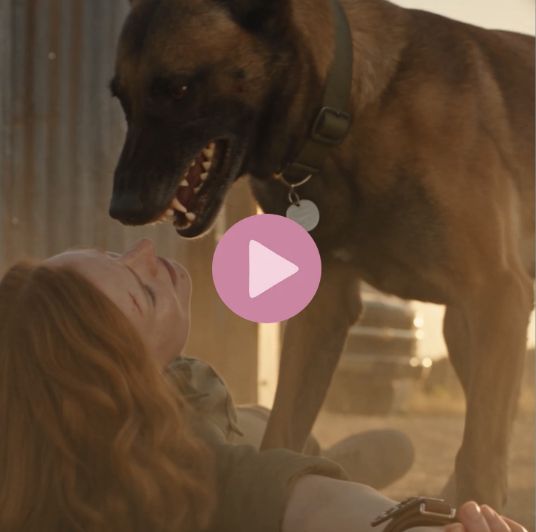
The woman tried to retreat, but the dog was already too close.
It slammed into her chest and knocked her onto the ground.
She raised both arms to protect her face.
“Don’t!”
“Please!”
The dog growled inches from her face.
Everyone watching expected the attack to become violent.
But then something completely unexpected happened.
The dog suddenly stopped.
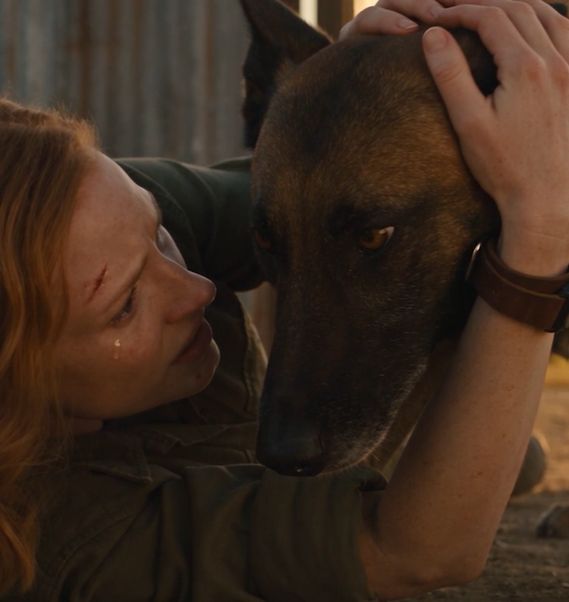
Its nose moved toward her wrist.
It sniffed her military bracelet once.
Then again.
Its entire body became still.
The aggression in its eyes slowly disappeared.
Its tail began to move.
Once.
Then twice.
The massive dog lowered its head and pressed its face against her chest.
The woman remained frozen beneath it.
“What are you doing?” she whispered.
The dog began making soft whining sounds.
Then she noticed something strange.
Tears appeared to be running from the corners of its eyes.
Slowly, she reached up and touched its head.
“It’s okay,” she whispered.
The dog pressed harder against her.
And then she saw the old collar around its neck.
Her breathing stopped.
She knew that collar.
Eight years earlier, during a deployment in Afghanistan, she had found a terrified young military dog hiding beneath a damaged transport vehicle.
The animal had been badly injured.
One of its front legs was bleeding, and someone had abandoned it after an attack on the base.
The young soldier who found it was named Emily Carter.
She had been twenty-six years old.
She wasn’t a dog handler.
She wasn’t even supposed to be near the damaged vehicle.
But she heard something crying underneath it.
“Hey, buddy,” she had whispered.
“Don’t be afraid.”
The frightened animal had slowly crawled toward her.
Emily spent the next several hours treating its wounds.
She shared her water with it.
She wrapped its injured leg.
And when the military handlers came looking for the animal, Emily refused to leave until she knew it would survive.
The dog eventually received the name Ranger.
But something happened that Emily never expected.
Ranger became attached to her.
Whenever Emily entered the compound, he would wait beside the gate.
Whenever she left, he would sit there until she returned.
She used to laugh about it.
“You know I’m coming back,” she would tell him.
Ranger would simply stare at her.
Then, one night, everything changed.
The base came under attack.
Explosions shook the compound.
Buildings caught fire.
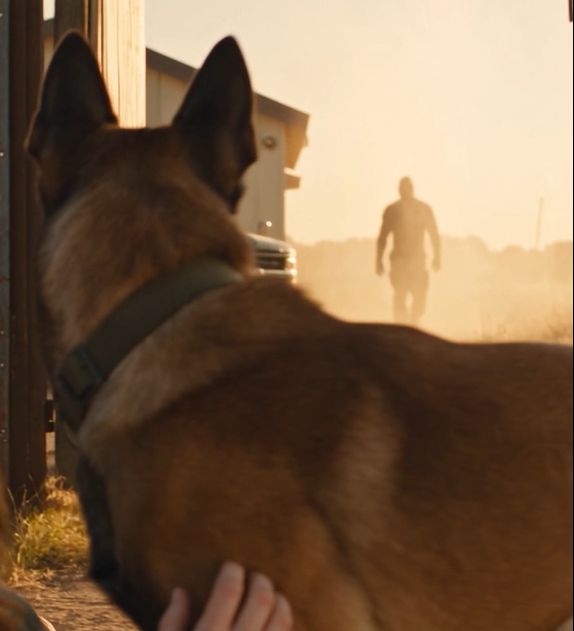
Soldiers rushed toward evacuation vehicles.
Emily was ordered to help evacuate wounded personnel.
Before she left, she ran to Ranger’s kennel.
She grabbed his old collar and tied it around his neck.
“I’ll come back for you,” she promised.
But she never did.
The helicopter carrying Emily and several wounded soldiers was struck shortly after takeoff.
It crashed miles away from the base.
Several people died.
Emily survived.
But she suffered severe injuries and was rescued by another unit almost two days later.
By the time she woke in a military hospital, she couldn’t remember her own name.
She had suffered a traumatic brain injury.
Her identification documents were gone.
Her uniform was destroyed.
And because the evacuation records had been damaged during the attack, the military initially listed her among the missing.
Months passed.
Then years.
Emily eventually recovered physically, but large pieces of her memory remained missing.
She remembered fragments.
A desert.
A burning helicopter.
A dog’s eyes.
A promise.
But she couldn’t remember Ranger’s name.
Meanwhile, Ranger had been transferred between military facilities.
He became a trained security dog.
His handlers discovered that he was exceptionally aggressive toward strangers.
He could detect unfamiliar scents from remarkable distances.
He was eventually assigned to guard a private military compound in the United States.
For eight years, he never allowed anyone to approach him without permission.
Until Emily walked through the gate.
She slowly pushed herself up from the ground.
Ranger refused to leave her side.
One of the handlers stared at them.
“Do you know this dog?”
Emily wiped her tears.
“I think I do.”
“You’ve seen him before?”
She looked at the collar.
“I saved him.”
The handler frowned.
“That isn’t possible.”
“Why?”
“Ranger was rescued overseas eight years ago.”
Emily stared at the dog.
“So was I.”
The handler immediately called the facility commander.
Within minutes, Emily was taken inside.
Military records were pulled from an old database.
Then someone found a photograph.
It showed a young female soldier kneeling beside an injured puppy.
Emily stared at the screen.
Her hands began shaking.
“That’s me.”
The room went silent.
Then the handler zoomed in on the dog’s collar.
It was the same collar Ranger was wearing.
But there was something else.
Attached to the inside of the collar was a tiny metal tag.
The tag contained a serial number.
That number matched a bracelet Emily had been wearing since the day of the crash.
Suddenly, Emily remembered.
Not everything.
Just one moment.
She remembered kneeling beside Ranger beneath the transport vehicle.
She remembered holding his face.
And she remembered telling him something.
“If you ever smell this bracelet again, you’ll know it’s me.”
The bracelet had been made from a special military alloy.
Emily had worn it for years.
But more importantly, during those first months after rescuing Ranger, she had carried him everywhere.
Her scent had become associated with safety.
With food.
With healing.
With survival.
Ranger had not recognized her face.
He had recognized the memory of her scent.
But there was still one question.
Why had Ranger waited for her for eight years?
The answer came from an old military veterinarian.
He explained that Ranger had developed a strange habit after Emily disappeared.
Every time someone opened the gate, Ranger would run toward it.
At first, the handlers thought he was simply being territorial.
But eventually they noticed something.
He wasn’t waiting for strangers.
He was waiting for one specific scent.
For years, Ranger had refused to sleep anywhere except beside the gate.
Every evening, he would lie there until the sun disappeared.
The handlers eventually stopped trying to move him.
They simply called it his “waiting place.”
Emily listened in silence.
Then she looked at Ranger.
“You waited for me?”
The dog slowly placed his head against her knee.
Emily began crying.
“I’m sorry I was gone so long.”
Ranger licked her hand.
For the first time in eight years, Emily remembered everything.
The attack.
The helicopter.
The hospital.
The missing years.
And the promise she had made to a frightened young dog.
She had told him she would come back.
And somehow, he had believed her.
Several months later, Emily officially adopted Ranger.
He was too old for active military service, but the military granted an exception because of their extraordinary history.
They returned to Texas together.
Emily placed Ranger’s old collar in a wooden box beside her bed.
But she never put it away completely.
Every morning, she would take it out and hold it for a few seconds.
Ranger would sit beside her and watch.
One day, Emily smiled and said, “You really never forgot me, did you?”
Ranger rested his head against her leg.
She laughed through her tears.
“I guess I owe you eight years.”
And from that day forward, Ranger never slept beside the gate again.
He slept beside Emily’s bed.
Because after eight years of waiting, the soldier who had once saved his life had finally kept her promise.
She had come back.
The Soldier Returns After 20 Years, But His Family Doesn’t Recognize Him
After twenty years, the American soldier finally came home.
But the strangest part was that no one in his own family recognized him.
The old military vehicle stopped in front of a weathered house in Texas just before sunset.
A man in a worn military uniform slowly stepped out.
His hair had turned almost completely gray, deep scars covered one side of his face, and he walked with a slight limp.
He stared at the house for several seconds, as if trying to convince himself that the place was real.
This was the home he had left when he was only twenty-four years old.
He had walked through that front door thousands of times.
He had eaten at the same kitchen table, slept in the same upstairs bedroom, and promised his mother that one day he would return.
Then he disappeared.
His mother opened the door first.
She stared at the stranger standing on the porch.
Behind her, his father appeared, immediately becoming tense.
His younger sister stood near the hallway, watching suspiciously.
The soldier removed his cap.
His mother studied his face but found nothing familiar.
Finally, his sister asked, “Excuse me, sir, can I help you?”
The man looked at her for a long moment.
Then he looked at his mother.
“Mom.”
She froze.
He swallowed hard and whispered, “I’m home.”
His father stepped forward.
“Who are you?”
The soldier reached into his pocket and pulled out an old photograph.
It showed a young man standing between his parents beside a much younger version of his sister.
“I know what I look like,” he said quietly.
“But I swear to you, I’m your son.”
His mother shook her head.
“No.”
She took a step backward.
“My son disappeared twenty years ago.”
“I know.”
“We buried him in our hearts.”
“I know.”
“Then why are you standing here?”
Before he could answer, a faint scratching sound came from the hallway.
Everyone turned.
An ancient golden retriever slowly emerged from the back of the house.
The dog was almost completely blind in one eye.
Its legs trembled beneath its aging body.
It had been adopted by the family years after their son disappeared.
The dog stopped when it saw the soldier.
For several seconds, nothing happened.
Then its ears suddenly lifted.
The old dog began trembling.
It took one uncertain step forward.
Then another.
Suddenly, it broke into a desperate run.
The dog crashed into the man’s chest, whining, licking his face, and wagging its tail so violently that its entire body shook.
The soldier dropped to his knees and wrapped both arms around the animal.
“Buddy,” he whispered.
The dog cried softly against his chest.
The man buried his face in its fur.
For the first time in twenty years, he began to sob.
His mother covered her mouth.
His father stared at the dog in disbelief.
His sister whispered, “That’s impossible.”
Because Buddy had been adopted three years after their son, Daniel, had officially been declared dead.
The family had never allowed the dog to meet him.
So how could Buddy possibly know who he was?
The soldier slowly looked up.
“Because I trained him.”
Silence filled the room.
His father frowned.
“That’s impossible.”
Daniel shook his head.
“No, Dad.”
“I didn’t adopt him.”
“I trained him.”
“Before I left.”
The family stared at him.
Daniel explained that twenty years earlier, he had been deployed overseas, and during a covert military operation, his convoy had been attacked.
His vehicle exploded.
Three soldiers died immediately.
Daniel survived but suffered severe burns, a traumatic brain injury, and partial memory loss.
When he was rescued, his military identification was destroyed.
Worse, the unit had been operating under false identities because of the classified nature of the mission.
For months, doctors tried to determine who he was.
But Daniel couldn’t remember his name.
He remembered fragments.
A house in Texas.
A red front door.
A woman’s voice calling him “Danny.”
And a dog that loved to sleep beside his bed.
But there was a problem.
The government had believed Daniel was dead.
His family had already been informed.
And because the mission had been classified, no one could publicly explain what had happened.
Daniel was eventually transferred to a rehabilitation facility under another identity.
Years passed.
His memories slowly returned, but by then, he had been legally registered under a new name.
He tried to contact his family several times.
Every attempt failed.
Then, six months earlier, everything changed.
Daniel found an old military record containing a photograph of his childhood home.
The sight of that house unlocked memories he had forgotten for decades.
He remembered his mother’s voice.
His father’s old truck.
His sister’s laugh.
And most importantly, he remembered Buddy.
But there was one final mystery.
Daniel had never told his family that Buddy had once been his dog.
When he was young, he had trained Buddy to recognize a special two-note whistle.
It was a sound no one else could imitate exactly.
Daniel looked at the old dog.
He placed two fingers against his lips and whistled.
Buddy immediately lifted his head.
The same whistle.
The same rhythm.
The same voice.
His mother finally understood.
She walked toward him slowly.
“Daniel?”
He looked at her.
“Yes, Mom.”
She touched the scar on his face.
Then she touched his hair.
And suddenly, she didn’t see the scars anymore.
She saw the little boy who used to run through the backyard.
She saw the young man who had hugged her before leaving for war.
She saw her son.
She collapsed into his arms.
“I’m sorry,” she cried.
“I’m so sorry we didn’t recognize you.”
Daniel held her tightly.
“You didn’t fail me.”
“You waited for me.”
His father stood silently for several seconds before finally stepping forward.
He placed one hand on Daniel’s shoulder.
“Son.”
That single word broke whatever strength Daniel had left.
He pulled his father into a hug.
His sister joined them moments later.
And on the floor beside them, Buddy continued wagging his tail.
That night, the family gathered around the same kitchen table where Daniel had eaten as a child.
For the first time in twenty years, there was an empty chair no longer empty.
But Daniel still had one question.
“Why did you adopt Buddy?”
His mother smiled through her tears.
“Because after you disappeared, we couldn’t bear the silence.”
“We thought having a dog would make the house feel less empty.”
Daniel looked down at Buddy.
The old dog was sleeping beneath the table.
His mother continued, “We didn’t know he had once belonged to you.”
Daniel smiled.
“Maybe he knew.”
And perhaps that was the strangest part of the entire story.
Everyone had forgotten Daniel’s face.
His family had forgotten the sound of his voice.
Even Daniel himself had forgotten who he was for many years.
But Buddy remembered.
He remembered the scent.
He remembered the voice.
He remembered the whistle.
And most importantly, he remembered the person Daniel had been before war, scars, and twenty years of silence changed everything.
Three weeks later, Daniel officially returned home for good.
His family framed the photograph of his return and placed it above the fireplace.
But Daniel kept one thing beside his bed.
An old, faded photograph of himself as a young soldier with Buddy sitting proudly beside him.
Underneath it, he wrote a single sentence.
“Twenty years disappeared, but you never forgot me.”
And every evening, even when Buddy could barely walk, the old dog would slowly make his way to Daniel’s room and lie beside his bed.
Because sometimes, family isn’t the one who recognizes your face first.
Sometimes, family is the one who remembers your heart when everyone else has forgotten.