Following a horrific wave of shark attacks across Australia, new details have emerged about the miraculous survival of Sydney schoolteacher Leah Stewart. As shockwaves ripple through coastal communities, marine scientists are exposing a terrifying shift beneath the surface — revealing why usually safe, patrolled waters have suddenly turned into volatile hunting zones.
The quiet morning calm at Sydney’s iconic Coogee Beach was violently shattered by piercing sirens, frantic screaming, and a sudden wave of sheer panic.
In a matter of seconds, what was supposed to be a routine, peaceful morning swim turned into a horrifying nightmare right inside the designated, patrolled safe zone.
Charlie Verco, a dedicated volunteer lifeguard who was paddling nearby, found himself plunging directly into a pool of deep crimson water in a desperate bid to rescue 35-year-old schoolteacher Leah Stewart.
Coogee Shark Attack Survivor Leah Stewart Awake & No Longer In Critical Condition
Gasping for air as he recalled the traumatic moment he reached her, Verco described the raw, brutal reality of the ambush that nearly took the young mother’s life:
“I heard violent splashing right inside the flagged safety zone. When I reached her, Leah was slipping out of consciousness, surrounded by a dense cloud of deep red blood. A great white shark, roughly 3.5 meters long, had just struck with precise lethality.”

Her arm completely severed by the sheer, devastating force of the 3.5-meter apex predator, Leah was hoisted above the water and rushed to the shore in a critical race against time.
Paramedics worked frantically to stabilize her on the sand before rushing her into the trauma unit, where doctors fought around the clock to save her life.
In the emergency room, as she briefly regained consciousness while fighting for survival, the brave mother used her faded strength to whisper a heartbreaking question to her husband:
“I love you… Is our daughter August okay?”
Against all odds, Leah survived the horrific encounter, but her narrow escape left the entire nation in a state of profound shock and lingering fear.
How could a massive great white shark strike with such calculated precision inside a patrolled, heavily monitored swimming area?
As local residents prayed for Leah’s long recovery, reports began flooding in from across the country, proving that her terrifying ordeal was far from an isolated event.
Just days prior to the Coogee Beach incident, thousands of kilometers away at Michaelmas Island in Western Australia, a peaceful family fishing trip ended in pure terror.
Witnesses recalled the harrowing, sudden moment the ocean surface violently turned against them without any warning:
“We were hauling in the nets when the surface suddenly churned into a dark, frothing mass. He only had time to yell out once before disappearing beneath the waves.”
By the time his frantic relatives managed to drag the victim back onto the boat, the physical damage was catastrophic.
“A massive portion of his body was gone. Just off the stern, a massive dorsal fin — at least 4.5 meters long — was still idly circling like a ghost.”
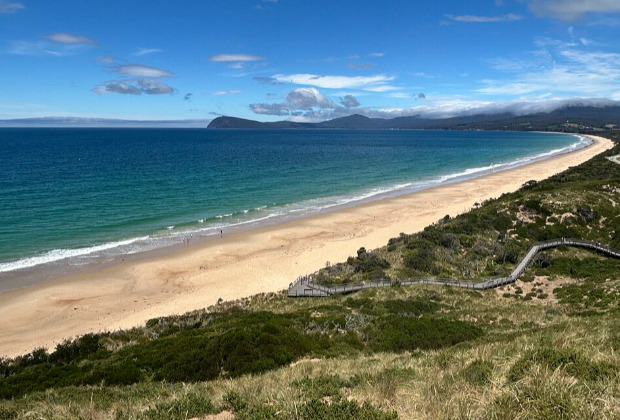
The relentless ocean surge continued its deadly path further south into the freezing, murky waters of Tasmania near Bruny Island.
A 31-year-old diver found himself locked in a life-or-death struggle with a predator notorious for its usually timid and docile nature.
Recalling the terrifying encounter from his hospital bed, the diver described the sudden, cold strike that caught him completely off guard:
“I had just speared a heavy fish and was pulling in the line when a dark shadow lunged straight at me. It didn’t go for the fish — it clamped directly onto my forearm.”
“The puncture marks felt like the bite of a large Alsatian. I suppressed the panic, clutched my arm tightly, and swam straight for the surface while shouting for my two buddies to apply a tourniquet.”
Three brutal attacks across three completely different states — from Western Australia and Sydney down to the freezing depths of Tasmania.
1000 members of our Coogee community came together to show support for Leah Stewart
What has sent public anxiety into an absolute frenzy is the erratic, completely unpredictable behavior demonstrated by these marine predators.
Species like the broadnose sevengill, which had barely recorded a handful of unprovoked human interactions over the past century, are suddenly striking humans with aggressive precision.
As beach closures spread nationwide and frightened swimmers abandon the surf, leading marine biologists are scrambling to unravel the mystery behind the sudden surge.
Why are sharks suddenly becoming far more aggressive, stepping outside their traditional feeding habits, and venturing directly into shallow human zones?
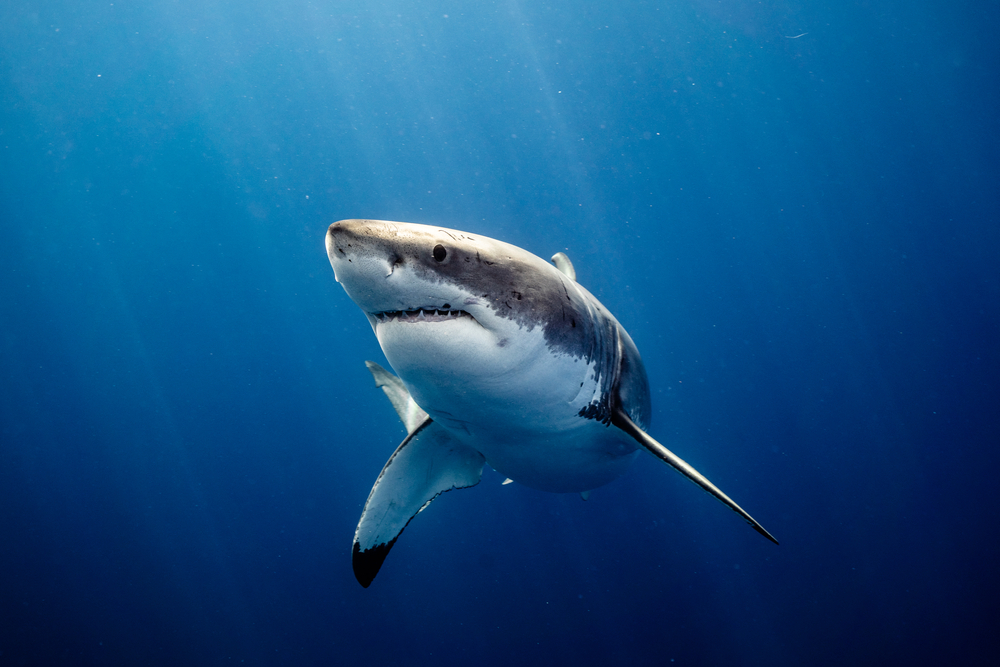
Faced with growing public panic, marine researchers have analyzed the underlying data, revealing three major environmental triggers driving this aggressive behavior.
First, Professor Culum Brown of Macquarie University points to an unusually dense “salmon run” hugging the Sydney coastline as a primary catalyst for the sudden shark influx.
Massive, calorie-dense shoals of Australian salmon have created an intense predatory trigger, drawing giant great whites directly into shallow, churned-up surf zones.
In the murky water near the shore, a swimmer’s moving limb — like Leah Stewart’s during her morning swim — is easily misidentified by a hunting shark as a struggling prey fish.
“Great whites do not target humans; they are testing mobile targets within their active feeding corridor,” experts explain, noting that the sharks strike out of predatory instinct rather than human malice.

A massive shoal of Australian salmon swimming close to the shallow coastal surf
Second, Dr. Lauren Meyer from Flinders University highlights how shifting global oceanic currents and fluctuating water temperatures are dramatically altering natural prey distribution.
Altered current paths have pushed cold, nutrient-rich water pockets — the primary habitat for species like the broadnose sevengill and great white — much closer to shallow bays and popular beaches.
As their natural food sources shift into new thermal layers, evolutionary drive forces these apex predators into expanded foraging grounds, heightening their competitive aggression when encountering active swimmers or divers.
Third, the sheer concentration of marine life near urban coastlines has created a high-risk environment where natural predator-prey dynamics spill directly into human recreational spaces.
High-tech AI-integrated drone surveillance scanning the nearshore surf for large ocean predators
In response to the alarming cluster of attacks and mounting public pressure, the New South Wales government has swiftly allocated $34 million AUD to deploy an advanced AI-integrated drone surveillance network across major beaches year-round.
Renowned marine authority Professor Rob Harcourt emphasizes that culling or scaring off sharks offers no real long-term solution, warning that humanity must adapt to the shifting dynamics of the sea.
As Leah Stewart continues her brave journey of recovery alongside her loving family, her miraculous survival stands as a powerful, sobering reminder of the ocean’s raw power.
The recent string of encounters serves as an urgent wake-up call for all Australians: beneath the idyllic blue surf, subtle ecological shifts are reshaping predator behavior, and the rules of the coastline have permanently changed.