The Heartbreaking Truth About Carrying the ‘Daicos’ Name…
Listen to the deafening roar of the Collingwood crowd on a crisp winter afternoon at the Melbourne Cricket Ground. It is a primal, intoxicating sound.
For over a decade in the 1980s and 90s, that exact roar was reserved exclusively for the “Macedonian Marvel,” Peter Daicos—a man who seemed to bend the laws of physics with a football. Today, that very same thunderous applause cascades down from the massive grandstands for his teenage son, Nick. To the casual observer, it is a beautiful, fairytale continuation of a legendary sporting dynasty. But behind the spectacular highlight reels, the dazzling footwork, and the adoring cheers lies an invisible, suffocating weight that almost nobody truly understands: the crushing psychological toll of inheriting the most famous surname in Australian Rules Football.
A Childhood Under the Microscope

The context of this immense burden requires an understanding of just how monumental Peter Daicos was to the Collingwood Football Club. He was not merely a champion; he was a deity in black and white. He achieved a god-like status, worshipped by the fiercely loyal “Magpie Army” for his seemingly impossible goal-kicking abilities and match-winning heroics.
Consequently, Nick’s childhood was never going to be normal. While other kids were learning the fundamentals of the game in quiet, muddy suburban parks, Nick’s formative years were spent under a permanent, glaring microscope. His junior football matches were routinely attended by talent scouts, journalists, and curious spectators desperate to see a flash of his father’s genius. He wasn’t just learning how to kick and mark; he was involuntarily enrolled in a masterclass on how to survive living life as public property.
The Terrifying Demand for Perfection
As Nick approached his draft year, this pressure mutated from a dull background hum into a deafening roar. The Australian sports media machine went into overdrive, analyzing his every move. Every single disposal, every decision, and every minor error in his under-18 games was heavily scrutinized and aggressively debated on national television.
Alongside the genuine excitement came the inevitable, venomous whispers of nepotism. Critics questioned whether he was genuinely a generational talent or simply a heavily manufactured product of his famous last name. The terrifying expectation thrust upon his young shoulders was not just to be good enough to make the elite level, but that he needed to be absolutely perfect from day one. He was expected to step onto the biggest stage in the country and immediately play like a 200-game veteran, carrying the hopes of the largest fan base in the nation before he even legally had the right to buy a beer.
The Hidden Mental Struggle
We often forget that beneath the elite athletic conditioning and the heavily branded team apparel is simply a teenager trying to figure out who they are. The hidden mental struggle of that reality is profound and isolating.
Imagine the quiet, solitary moments of self-doubt a young man faces when his every inevitable mistake is instantly compared to an immortalized legend. How do you mentally process the fact that your absolute best might still be measured against a heavily romanticized, nostalgic version of your father? The fear of failure is a universal human experience, but for Nick, failure didn’t just mean a poor individual performance—it meant letting down his family legacy and disappointing a rabid fan base that felt a profound sense of ownership over his career. It is a psychological tightrope that has broken many talented “sons of guns” before him.
Silencing the Haters
This dynamic was further complicated by the fiercely tribal nature of the AFL. Because of the sheer volume of media hype surrounding his arrival, rival fans initially and desperately wanted him to fail. They were sick of hearing the name “Daicos.”
Opposing supporters filled internet forums and talkback radio lines labeling him an overhyped product of severe media bias, eagerly waiting for the moment he would crack under the immense pressure. They wanted the narrative of the privileged “nepo baby” falling flat on his face. However, those dissenting, hateful voices were silenced with breathtaking speed. Nick didn’t just step up to the level of elite football; he completely transcended it. His sheer brilliance, his elite decision-making, and his staggering work rate dismantled the nepotism argument week after week, forcing even the most bitter rivals to grudgingly admit they were witnessing something extraordinarily special.
Forging an Identity from Public DNA
Looking back at his meteoric rise, one must deeply analyze the staggering emotional maturity required to forge your own distinct identity when your very DNA is considered public property.
It requires a Herculean level of psychological resilience to block out both the deafening praise and the vicious criticism, choosing instead to focus entirely on your own path. Nick had to accept that while his surname opened the door, only his relentless work ethic, grit, and undeniable talent could keep him in the room. He had to honor his family’s incredible legacy without allowing it to become his psychological prison.
Redefining the Shadow
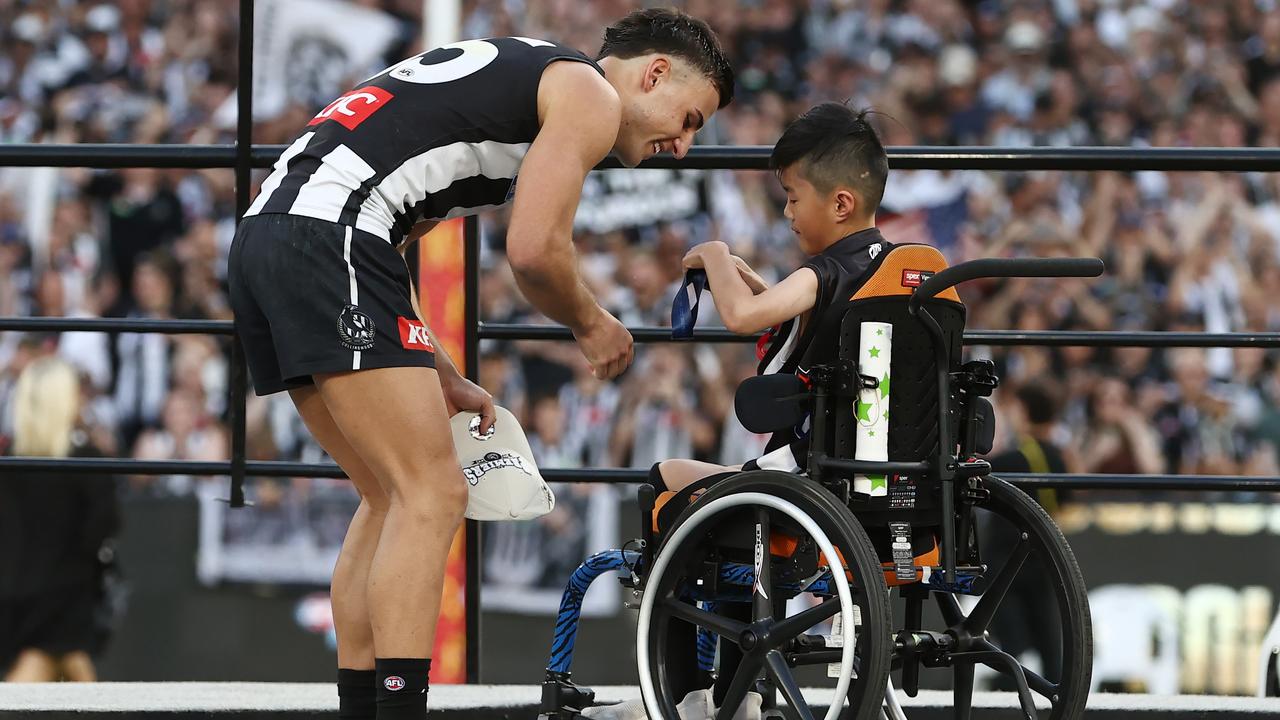
Ultimately, the story of Nick Daicos is not a tragedy of crushed expectations; it is a triumphant masterclass in resilience and self-belief. He faced the crushing, invisible weight of a sporting dynasty and flatly refused to be broken by it.
Nick didn’t just survive the colossal shadow cast by the “Macedonian Marvel”—he completely redefined it with his own unique brand of footballing genius. He stepped onto the hallowed turf of the MCG and wrote his own name into the stars, entirely on his own merits. And perhaps the greatest, most emotionally resonant testament to his success is the subtle shift in how the football world now speaks about his family. Because of his profound, undeniable impact on the game, he isn’t just Peter’s son anymore. In the eyes of a completely new generation of football fans, Peter is now Nick’s dad.